
Tracing Rudraksha (roo‑DRAAK-sha) Across Time and Traditions
On a sunny afternoon, you’re supposed to be on a retreat—ready to flow through yoga poses, meditate, and find your inner zen—but somehow you’ve ended up cramming into the cutest boutique shop in town. Maybe it’s the artisanal lanes of Carmel Valley, a coastal street in Monterey, the creative avenues of Berkeley in California, the mindful streets of Boulder, Colorado, or the serene little corner of the Isha Gift Shop at the Isha Institute in McMinnville, Tennessee.
The shelves are stacked with yoga mats, essential oils, incense, meditation tools, and mindfulness books, the air rich with the scent of burning incense. A few fellow seekers meander through the aisles, rocking loose kurta tops and soft pajama pants, cotton bags slung over their shoulders like badges of enlightenment. They pause thoughtfully at paintings, pottery, hand-crafted décor, and beaded necklaces.
And then, your eyes land on one strand: Rudraksha (roo-DRAAK-sha).
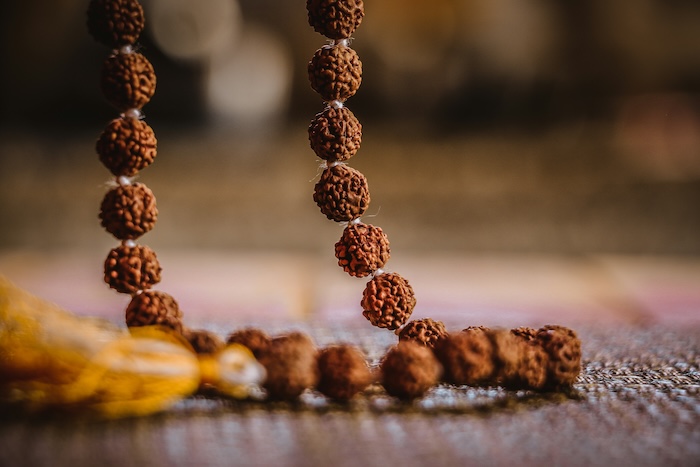
Earthy brown, naturally ridged, round, some beads large, some small, strung together simply yet deliberately. Sliding the beads through your fingers has a gentle friction grounding, and rhythmic.
It is not flashy, yet the weight and texture hint at centuries of care, movement, and meaning. A small card tells part of the story: beads born from the symbolic tears of Shiva, worn by seekers for focus, stillness, and conscious intention.
From this tactile moment, the story of Rudraksha begins — a journey across time and space, from the Himalayan forests to monasteries in Nepal and Tibet, trading ports in Southeast Asia, and into spiritual boutiques and meditation spaces across the United States.
Each strand becomes a bridge linking ancient craft with contemporary intention — East and West, nature and human aspiration, inner life and timeless teaching.
Rudraksha has deep roots in India, appearing in ancient texts exploring awareness and presence. Early writings describe beads used in repetitive practices to support focus, such as prayer beads in many cultures. In Indian tradition, a strand of 108 beads is a practical tool for meditation and maintaining attention – think of them as spiritual fidget beads before fidget spinners were cool. In South Asian contexts, beads have long aided calm, focus, and contemplative practice.
In Nepal, where Rudraksha trees grow naturally, beads hold everyday cultural significance. Artisans in mountainous districts like Bhojpur carefully extract and prepare them, and locals wear them both as malas and everyday adornments. Here, Rudraksha is craft and companion—a tactile reminder to stay present in daily life.
Beyond Hindu practice, Rudraksha traveled into Himalayan Buddhist monasteries, aiding concentration and reflection. Trade carried it to Java, Bali, and Sumatra, where communities integrated it into devotional and contemplative practices. Across cultures, the bead maintained its essence: a tool to anchor attention, a reminder that even a small seed can connect inner life to larger rhythms.
Across cultures, the bead maintained its essence: a tool to anchor attention, a reminder that even a small seed can connect inner life to larger rhythms.
Today, Rudraksha appears in yoga studios, meditation shops, and mindful communities across the United States. It is not just a relic but a tactile anchor for breath awareness, reflection, and conscious intention. From retreats to urban meditation spaces, from coastal towns to the Isha Gift Shop in Tennessee, the bead connects people to a lineage of attentive living.
Rudraksha is more than an adornment; it is a portable cultural tapestry.
It carries the hands that harvested it, the markets that traded it, and the minds that have used it for centuries. Each bead echoes attentive living, a quiet prompt to focus — not just on spiritual identity, but on presence itself.
Hold a strand in your hand, and you touch a thread running from mountain valleys to coastal retreats, from ancient paths to modern minds — a bead inviting you not just to wear it, but to notice it.

Plus receive a free eBook by Sadhguru