So you’re curious about Rudraksha—and you’ve seen it in yoga boutiques, online meditation shops, or on someone’s neck during a retreat. But how do you choose the right one? What does all the talk about “mukhis,” mala size, and consecration really mean? This guide cuts through the noise with clear, practical advice—especially for first-time buyers.
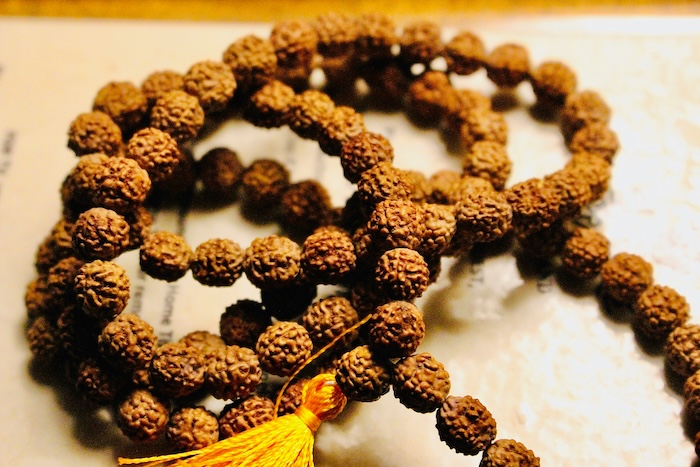
At its simplest, a Rudraksha (roo-DRAAK-sha) is the dried seed of the Elaeocarpus ganitrus tree. In yogic tradition, it’s considered a tool for physical balance, mental clarity, and spiritual focus—not just decoration. You don’t need to belong to a specific religion to wear one; anyone with a desire for stability can benefit.
You don’t just wear a Rudraksha; you carry a centuries-old practice of conscious living.
1. Start by Knowing Your Purpose
Different Rudraksha types are defined by their mukhis (the “faces” or natural lines on the bead). Each type is traditionally associated with different supportive qualities:
- Panchamukhi (5-faced): The “all-rounder.” Recommended for general well-being, calmness, and clarity. It is suitable for practically anyone over age 14.
- Dwimukhi (2-faced): Often suggested for harmonious relationships; married partners sometimes wear a pair to balance their shared energy.
- Shanmukhi (6-faced): Commonly worn by children under 14 to support balanced physical and mental growth.
- Gowri Shankar: Two beads naturally fused, said to aid prosperity and balance the major energy channels (Ida and Pingala).
For beginners, the Panchamukhi is almost always the best place to start. Highly specific beads (like 1, 12, or higher faces) are often tied to advanced practices and are ideally selected with expert input.
Stability isn’t a miracle; it’s a mechanical state we can support with the right tools.
2. Mala Size and Bead Count
A traditional Rudraksha mala is strung as a necklace where the beads touch one another. Ideally, they should be strung loosely enough to move freely but not so loosely that the mala feels awkward.
For adults, a full mala usually contains 108 beads plus one bindu (the extra “guru” bead). However, any number above 84 plus a bindu is considered substantial. While smaller beads (e.g., 5mm) are rarer and often more expensive, they don’t necessarily “work better” than 7mm beads—size is largely a matter of personal comfort and style.
3. Authenticity: Why Source Matters
With Rudraksha, authenticity is everything. The market is flooded with plastic, carved, or “glued” fakes. A real bead looks organic, feels firm, and has clearly defined faces.
A traditional check mentioned by Sadhguru involves holding the bead over water; the bead must move clockwise if the substance is “positive” or life-supportive and anti-clockwise if “poisoned”. While not a laboratory test, it offers an experiential cue for the buyer. The most reliable way to ensure you are getting the real deal is to source from a reputable place like Isha Life, where beads are checked, quality-verified, and energized in the sacred space of the Dhyanalinga.
The most sophisticated technology isn’t always the newest—it’s the one that has quietly anchored humanity for centuries.
4. Wearing and Maintenance
To get the most out of your first Rudraksha, keep these “house rules” in mind:
- The String: Use cotton or raw silk thread. Metal chains are fine, but ensure the seeds aren’t being pinched or stressed.
- Consistency: Wear it at all times, even while sleeping. However, avoid contact with hot water or chemical soaps, as these can strip the natural oils and cause the seed to crack.
- Conditioning: New beads should be soaked in Ghee for 24 hours, followed by full-fat Milk for another 24 hours. This “feeds” the seed and ensures it lasts for decades. Repeat this process every six months.
The Bottom Line
Choosing a Rudraksha doesn’t have to be complicated. Focus on authenticity, a comfortable size, and a type suited to your intention. Whether you seek a “shock absorber” for your nervous system or simply a grounded talisman for your daily life, the Rudraksha offers a quiet, powerful way to anchor your attention in the present.

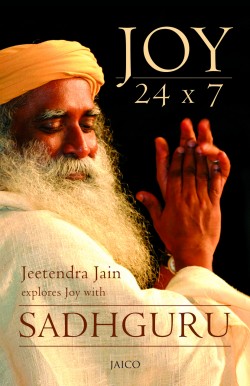
Plus receive a free eBook by Sadhguru