
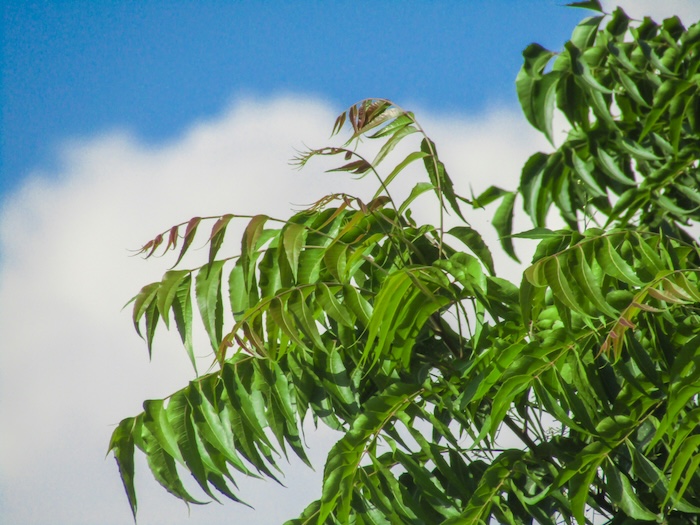
In the sun-soaked villages of India, one tree has silently watched over generations — the neem tree (Azadirachta indica). Its dark, serrated leaves, pale flowers, and bitter fruit carry whispers of healing, protection, and quiet magic. For centuries, people have turned to it for remedies, shelter, and comfort — a presence as natural as the soil itself.
Beneath its canopy, life paused for a moment of relief, a sip of healing, a breath of shade.
Children chase shadows under its wide branches. Mothers steep its leaves in hot water for cooling teas. Farmers tuck their branches into grain stores. The sharp, clean scent of neem and the rustle of its leaves have always marked a space of care and attention.
Where Legends Touch Leaves
Neem’s story is stitched with myth. One tale from ancient India describes the Samudra Manthan, the churning of the ocean to bring forth immortality. A few sacred drops landed on a sapling, transforming it into a tree of healing. In another story, the Sun God found shade beneath a neem, its leaves offering relief from relentless heat.
In villages, neem is also associated with Goddess Shitala, protector against fevers and disease. During festivals like Ugadi, families hang neem leaves at doorways — a simple gesture of protection, blending daily life with reverence. The cool green leaves, their bitter taste, and fresh aroma carry both warning and promise: health and home are intertwined.
Neem leaves hung at doorways during festivals, a centuries-old practice for protection and purification.
Daily Medicine, Quiet Miracle
Neem’s usefulness is woven into every part of life. Leaves crushed into pastes soothe the skin. Twigs chewed clean teeth. Flowers flavor festive dishes. Seeds pressed into oils. Bark boiled for remedies.
Centuries of observation created living knowledge — long before modern labs confirmed that neem contains antibacterial, antifungal, anti-inflammatory, and insect-repelling compounds.
Bitterness that heals. Shade that shelters. Neem teaches by presence, not proclamation.
A Tree That Speaks Across Worlds
Neem may not grow in North America, but its story resonates with Indigenous traditions. Many Native peoples see trees as living guardians — sources of medicine, protection, and spiritual guidance. The cedar of the Pacific Northwest and the sacred oak of the Delaware (Lenape) are not just trees; they are teachers and companions. The Ojibwe honor the “Witch Tree” on Lake Superior, leaving offerings and prayers.
Like neem, these trees are integral to daily life, blending practical use with cultural wisdom, showing how humans everywhere recognize the life and spirit of trees.
Sacred trees across cultures — neem in India, cedar in North America — bridges of healing and reverence.
Bitterness That Brings Balance
Neem reminds us that healing is rarely sweet. Its leaves, flowers, and seeds carry natural bitterness that calms fevers, purifies water, soothes skin, and wards off pests. It is medicine, shield, and teacher rolled into one tree — always present, always asking for attention.
Across centuries and continents, neem has taught the same lesson: the most ordinary-looking tree may hold extraordinary power. Its presence in kitchens, village squares, and sacred groves speaks of observation, care, and interconnection — a wisdom older than words.
Neem’s bitter leaves and soothing shade — living proof that nature carries both science and story.

Plus receive a free eBook by Sadhguru