
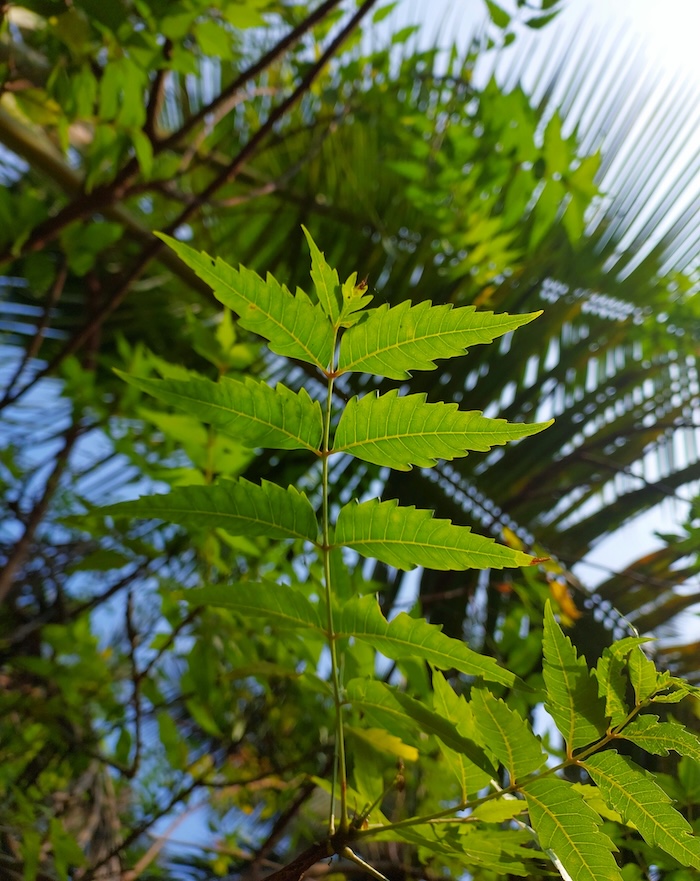
At the Isha Institute of Inner-sciences in Tennessee, the environment has a way of sharpening your senses. It is a place where the subtler aspects of life are given room to breathe, and the connection between the human body and the natural world becomes visible. As you move through the consecrated abode and prepare to step back into the world, a volunteer reaches out and drops a few small, jagged green leaves into your palm.
Neem.
You pop them into your mouth, and immediately, your face contorts. Your eyebrows knit together, your jaw tightens, and your senses recoil in a geometric puzzle of involuntary protest. It is a bitterness so absolute it feels like a physical confrontation. But as the shock fades, an ancient wisdom resonates:
“What is not good for your tongue is often a great blessing for your health.”
The Science of Luminosity
To the casual eye, this is just a leaf. However, as Sadhguru explains Why Vilva & Neem Are Dearest to Shiva | Sadhguru, every substance in existence—whether a leaf, a pebble, or a human body—is constantly exuding a certain level of light and energy. Modern science confirms this 100%, yet our physical eyes are often not sensitive enough to perceive it. Just as we are always touching the air but only feel it when it blows at a certain speed, our senses only catch a narrow band of the frequencies that surround us.
In this “Garden of Sacred Flowers and Leaves,” the Neem leaf stands apart. It is considered sacred because it exudes sometimes 100 times more energy than other substances. When you begin to perceive life through the “Third Eye”—the dimension of inner perception—the biological classification of the plant becomes less significant than the high-frequency impact it has on the human system.
The $1,800 Wake-Up Call
What is truly fascinating is that this “bitter friend” eventually traveled from the village squares of ancient India to the high-tech research centers of the United States. In the 1990s, the U.S. Patent and Trademark Office began receiving applications for Neem (US Patent No. 5,124,349) and Turmeric (US Patent No. 5,401,504).
While these patents were eventually restructured to keep the plants in the “public commons,” the attempt itself was a massive validation.
Sadhguru tells a story that puts this value into perspective. Having never visited a dentist until he was 42 years of age, he eventually found himself in a clinic in Atlanta due to dental pain. After a $600 bill just for an X-ray, he was told he needed a root canal that would cost $1,800.
Instead of the procedure, he returned to India and for twelve days simply brushed his teeth with a neem stick. The pain vanished, and he hasn’t been to a dentist since. This is not to say modern medicine is not important—it has performed absolute miracles in saving lives and addressing trauma. However, many issues can be prevented or managed if we simply pay attention to the natural tools at our disposal. Sometimes “somebody has to shock you with a bill” to make you recognize the value of what is already available in nature.
The Theme: A Gift That Belongs to All
The beauty of Neem is that it is nature’s open-source code. They are available to everyone—from the devotee at the temple to the scientist in a white coat.
When we look at the history of these patents, we should not see a conflict. We should see a celebration. It is the story of the whole world finally waking up to the same truth: that the most powerful things on Earth don’t always taste sweet, and the best medicine often grows right by our doorstep, free for all to use: it is a gift that should be available to all.

Plus receive a free eBook by Sadhguru